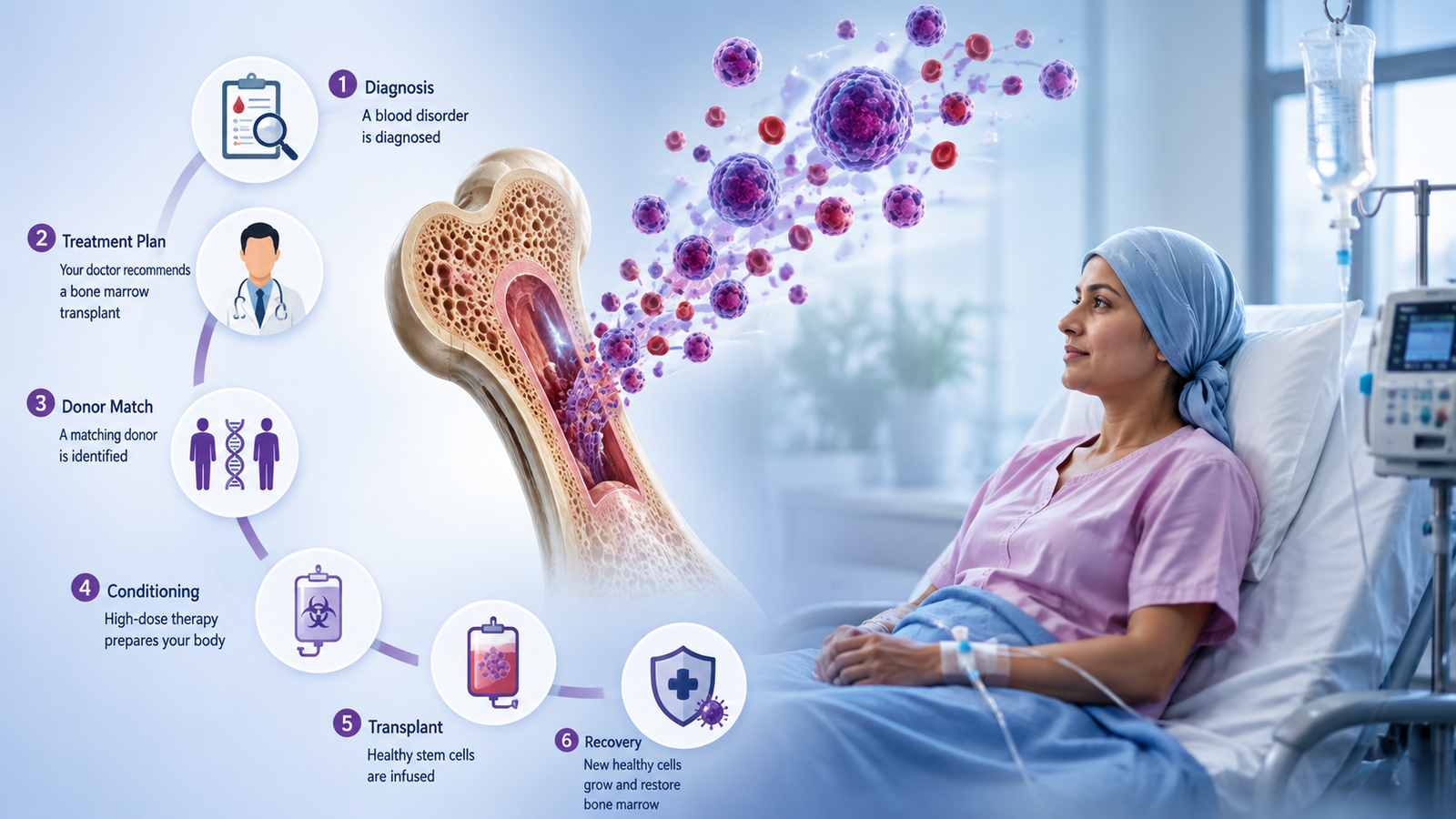
Bone Marrow Transplantation (BMT) — also called Hematopoietic Stem Cell Transplantation (HSCT) — is one of the most powerful treatment options available for a range of blood cancers and bone marrow disorders. As a BMT Fellow at Max Super Speciality Hospital, I work with these patients every day. In this article, I want to break down what the procedure actually involves in plain, simple language.
What Is the Bone Marrow and Why Does It Matter?
The bone marrow is the soft, spongy tissue found inside your larger bones — the hip, sternum, and spine. It is your body's blood factory. Every day it produces millions of red blood cells (which carry oxygen), white blood cells (which fight infection), and platelets (which help clotting). When disease — or the chemotherapy used to fight it — destroys this capacity, the body can no longer sustain life without intervention.
What Is a Bone Marrow Transplant?
A BMT replaces damaged or destroyed bone marrow with healthy stem cells — either from the patient's own body or from a matched donor. These stem cells travel to the bone marrow and restart healthy blood cell production. It is not a surgical procedure in the conventional sense — the stem cells are infused through a drip, similar to a blood transfusion.
Types of Bone Marrow Transplant
Autologous BMT: Stem cells are collected from the patient's own body before high-dose chemotherapy, stored, and then reinfused after treatment. This is the most common approach for Multiple Myeloma and certain Lymphomas.
Allogeneic BMT: Stem cells come from a matched donor — ideally a sibling with identical HLA markers, or an unrelated matched donor. This is used for Acute Leukemia (AML, ALL), Myelodysplastic Syndromes, and Aplastic Anaemia.
Who Needs a BMT?
Common conditions treated with BMT include Acute Myeloid Leukemia (AML), Acute Lymphoblastic Leukemia (ALL), Multiple Myeloma, Hodgkin and Non-Hodgkin Lymphoma, Aplastic Anaemia, and Myelodysplastic Syndromes (MDS).
What Does the Process Look Like?
Step 1 — Pre-Transplant Evaluation: Comprehensive testing to confirm the patient is fit enough for high-dose treatment. Step 2 — Conditioning: High-dose chemotherapy (with or without radiation) to destroy existing diseased marrow and suppress the immune system. Step 3 — Transplant Day: The stem cell infusion itself — usually takes a few hours through a central line. Step 4 — Engraftment: Over 2 to 4 weeks, the new stem cells travel to the marrow and begin producing blood. This is the most critical and vulnerable period. Step 5 — Recovery & Follow-Up: Monitoring continues for months to years — watching for GVHD, infection, and relapse.
Have Questions?
If you or a family member has been advised to consider a bone marrow transplant, early specialist consultation is essential. Please reach out via WhatsApp or email — I am happy to guide you through the process.